Contents
2.2.1 Group Leadership: Lewin et al
2.2.2 Group Leadership: McCann
2.3.2 Vroom-Yetton-Jago Normative Decision
Model
2.4 Functional or Group Theories
2.4.1 Adair’s Action-centred Leadership
2.5 McGregor's "Theory X and Theory
Y"
3. easyJet Airline Company plc.
1. Introduction.
The Organisations is made up of group of people. A momentous part of management is coordinating the activities of the group and directing the efforts of their members towards the goals and objectives of the organisation. This involves the development of leadership and the choice of a proper form of behaviour.[1] As the 21st Century begins, an international trend away from the traditional autocratic and hierarchical modes of leadership starts. Within several companies, a renew interest of employee participation is been fuelled by the introduction of contemporary managerial strategies such as total quality management.
Much has changed on the shop floor of organizations today. Decision-making takes place at lower levels of corporations. The hierarchical, “top down” management style of the past gives rapidly way to a system where employees take responsibility for their own actions and leadership comes from employee teams. It does not necessarily mean that leadership always makes decisions at the lower levels, but rather oversees the decisions that are made and that they fit the direction of the organisation. This has a direct affect on the organisational composition.[2]
Team-based environments present an additional challenge for leaders. It is necessary for them, to be able to recognise their people as assets and blend them together. They need to have the aptitude of blending the organisation, from top management to bottom levels so that everybody is brought into the organisation. Also, is very important for the leaders to be able to inspire their people in terms of creativity, capacity, and commitment. Authority has been transferred away only to provide leadership more dynamics to work with. Leadership must build relationships with interest within the organisation, whether it is the employees, customers, investors, suppliers and or the entire community.[3]
As a result of this change the investigation faces the issue of what is in reality the most effective way for an organisation to develop a leadership style. Is there any evidence that suggests a formula suitable for today’s Internet business?
Technological
development using intranet sites, computers, digital links, virtual offices,
are being generated in limitless volumes, and with the help of faxes and mobile
phones communication is moving faster and faster. Organisational structures
will without doubt change when dealing with electronic markets and information
highways. Leadership will be confronted with the obstacle of marketing products
that have little or no human intervention.[4]
A young
organisation has been emerged in this environment of change for being rabidly
developed in a new industry in the UK, of low cost airlines. easyJet Airline
Company Ltd was in 1995 to break new ground to a new evolutional means of doing
business. The use of technological development in several aspects and more
importantly investing on the power of the Internet make the company today one
of the most successful in this sector. Major role on this development played
the owner and creator of the idea (taken from American bases) in UK, Mr Stelios
Haji-Ioannou. A young and innovating ‘entrepreneur’ character,
as he characterises himself with evolutional ideas and creativity, together
with strong leadership characteristics.[5]
The key for
leaders is to recognise the winds of technological change that comes and to
proactively prepare to integrate it into the business strategy and operations.
Leadership must cover the way and guide the organisational constructs to engage
with the challenges of the information age.
The objectives of
this project are fundamental. Concentration is given on:
- First, to investigate if leadership in Internet organisations is
an important element for the development and successful business life.
- To determine the leadership style that most suites the today’s
Internet organisation, if actually there is a particular one.
- To determine those changes, that has occurred and will arrive in
the near future in terms of leadership development and organisational
structure.
- Lastly, to recognize those changes within the structure of easyJet
Airline Company Ltd.
The centre of the investigation
is to identify the value of leadership styles and the role that play into the
operation of an organisation. In order to achieve the above analysis will be
concentrated on a new company that was developed during the last years and has
achieved great profits, based on a new idea of low cost airline industry and
its operation mainly online. easyJet plc is the company under investigation and
the particular leadership styles techniques during its operation.
One of the reasons
of its success is its leadership style technique that it will be investigated
in detail and classified its value on the company’s operation. Through this
investigation a conclusion on the value of leadership in today’s world of
business will materialize to become a good example for present use and future
development.
1.1 Definition of Terms
1.1.1 Leadership
According to Yukl, (1994), most definitions of leadership reflect the assumption that it involves a social influence process whereby one person exerts intentional influence over other people, in order to carry out specific activities or relationship.[6] So in other words is either based on a function of personality, or it can be seen as a behaviour category.[7]
Many successful and interesting theorists have developed different approaches of Leadership during the years. The most significant and applicative for the Internet environment of these theories are the following
Mullins L., G., (1996) gives a fair definition of those theories. First of all according to him (1996: 260) “Qualities or Traits approach assumes leaders are born and not made. Leadership consists of certain inherited characteristics or personality traits. Focuses attention on the person in the job and not on the job itself”. Also, Behavioural Theories as Mullins L., G., (1996: 260) points out are “ The kinds of behaviour of people in leadership position and the influence on group performance. Draws attention to range of possible managerial behaviour and importance of leadership styles”. Moreover, he defines Contingency Theories or Situational approaches as “the importance of the situation. Interactions between the variables involved in the leadership situation and patterns of behaviour. Belief that there is no single style of leadership appropriate to all situations”. Last but not least, in The Functional or Group Theories attention is focused on the functions and responsibilities of leadership, what the leader actually does and the nature of the group. Assumes leadership skills can be learned and developed”.
Each of those theories will be analysed and discussed in detailed individually in the following paragraphs.
2. Theories
2.1 Traits Theories
The trait theory of leadership focuses on the personality,
intellectual and physical traits that distinguish leaders from non-leaders.
Many studies of such traits have shown just negligible differences between
leaders and followers. Research has exposed that leaders tend to be fairly
larger, brighter and better adjusted than their followers. Early studies
reported that the effective leader shows traits of "nervous and physical
energy, a sense of purpose and direction, enthusiasm, friendliness, integrity,
technical mastery, willpower, intelligence, teaching skills, and faith."
However, other studies have point out the traits of effective leaders were
thought to be "physique, technical skill, perception, knowledge, memory,
imagination, determination, persistence, endurance, and courage."
Additionally, other researchers have indicated leadership traits to be "an
above average education, activity in social organizations, and high moral and
ethical standards". Clearly, a basic problem with the trait theory of
leadership is that theorists do not agree as to which traits are attributable
to effective leadership. While the above qualities seem to be desirable in an
effective leader, no one trait seems to be absolutely essential[8].
According to
those theories a human’s character is developed over time. Many people believe
that the character is mainly formed during the early stages of life. However,
nobody knows exactly how much or how early the character is developed. On the
other hand, it is safe to state that human’s character does not change rapidly.
A person's observable behaviour is an indication of his character. This
behaviour can be strong or weak, good or bad. A person with strong character
shows drive, energy, determination, self-discipline, willpower, and nerve. He
expresses what he wants, goes after it and attracts followers. In contrast, a
person with weak character shows none of these traits. He does not know what he
wants, his traits are disorganized, he hesitates and is conflicting, and
consequently he attracts no followers[9].
2.2 Behavioural Theories
2.2.1 Group Leadership: Lewin et al
Lewin, Lippitt and White
Lippitt R. and White
R.K. conducted one of the best-known
studies of the special effects of dissimilar leadership styles in the 1930s.
Known as 'Leadership and Group Life', the study was conducted under the
leadership of Kurt Lewin (1939)[10].
It took place in University of Iowa, and involved directing groups of
schoolchildren in the production of arts and crafts artefacts in four different
clubs. They had three types of leader assigned to them:
- Authoritarian -
this leader was to remain aloof and to use orders without consultation in
directing the group activities.
- Democratic -
this leader was to offer guidance, encourage the children and participate
in the group.
- Laissez-faire -
this leader gave the children knowledge, but did not become involved and
generally participated little in the group's activities.
The groups were carefully coordinated for IQ, popularity,
energy and so on and all worked on the same project of making masks.
Results
- Democratic – In these groups morale was high,
relationships between the group members were friendly, as well as with the
group leader. When the group leader left the room, the group showed itself
skilled of working independently. The group illustrated a fair amount of
originality, and, although they produced rather less than the 'authoritarian'
group, the quality of their productions was considered higher[11]
- Authoritarian - In these groups, there were found to
be two different types of behaviour - 'aggressive' and 'apathetic'. The
aggressive children were disobedient and continually demanded attention
from the leader, as well as tending to blame other members of the group if
anything went wrong. On the other hand, the apathetic children placed
fewer stress on the leader and were less critical of him, but, when they
were given a non-authoritarian leader, they tended to fool around and
engage in horseplay. The groups' productivity was higher than the
'democratic' groups, but the quality of their masks was not as high
(Ibid).
- Laissez-faire –These were the worst groups of all.
They did not produce many masks and those they produced were of poor
quality. Their group pleasure was the lowest; they slightly co-operated
and placed great demands on the leader, showing little aptitude to work
independently (Ibid).
Conclusions
Overall, then, the democratic
leadership style seemed to be the most successful, though it's worth indicating
that some boys preferred the authoritarian style, especially one boy whose
father was an army officer. This might suggest that the boys responded best to
the leadership style they perceived as 'right' or 'natural' and, since they had
grown up in the USA, where great emphasis is placed in schooling on the
democratic traditions, it could be that they had been socialised into
perceiving the democratic style as the 'right' one for leaders to adopt (Ibid).
Also, it could be that
different leadership styles are suitable in different circumstances. Certainly,
it seems that every so often in democracies people desire a strong leader who
usually without delay step on all over their democratic freedoms. Hitler and
Mussolini are obvious examples, but de Gaulle in France in 1958 and Thatcher in
Britain in 1979 are presumably also symptomatic of the same depression (Ibid).
2.2.2 Group Leadership: McCann
McCann: The Team Management Wheel
Dick McCann is a
management consultant, who, together with Charles Margerison developed the
so-called Team Management Wheel in 1984. The aim of the Team Management Wheel
is to place at the centre of management teams the basic insight that people
like to work in different ways. It tries to make clear what those different
preferred styles are and to show how they relate to each another. Thus,
McCann's ideas, which derive from 'neurolinguistic programming', do not in
fact constitute a theory of personality types, but a theory of people's working
preferences[12].
Preferred working styles
According to McCann and
Margerison, there are essentially four sliding scales, which indicate how
people prefer to work (Ibid). Those scales are the following:
- How people prefer to relate to others
INTROVERTED <===> EXTROVERTED
Some people will have an extroverted approach, talking things through with others and enjoying a wide variety of different asks; others will prefer to think things over and won't have a high need to discuss things with others (Ibid). - How people prefer to gather and use information
PRACTICAL <===> CREATIVE
Practical people prefer tried and tested ideas, paying attention to the facts and details; creative people will be less constrained by tradition, will be future-oriented, won't mind uncertain situations and will enjoy looking at possibilities (Ibid). - How people prefer to make decisions
ANALYTICAL <===> BELIEFS
Analytical people will gather the information and then set up objective decision-criteria, trying to find the solution which maximises the pay-off; others will be more constrained by their beliefs, principles and values (Ibid). - How people prefer to organize themselves and others
STRUCTURED <===> FLEXIBLE
Some like a structured environment, where everything is neat and tidy and decisions are made quickly; others prefer to be more flexible and make sure that all possible information has been gathered before decisions are reached - they'll tend to put off 'concluding' until they have gathered all the information they can (Ibid).

McCann’s ‘Team Management Wheel’
The Team Management Wheel provides a visual
representation of the main differences between people. Generally people show a
preference for one of the key positions on the Wheel and two related 'backup'
roles. For example, they might see themselves as a 'creator-innovator' with
related backup roles as 'thruster-organizer and 'concluder-producer'.
It is fairly easily fir someone to
understand how the positions on the Wheel relate to the working styles outlined
above. For example, the 'explorer-promoter' is the consequence of an
interaction between the extrovert and creative dimensions, giving people a
preference for selling ideas and generally being entrepreneurial (Ibid).
Distribution of roles
McCann and Margerison's
work has produced the following data on a population of 3730 managers from the
UK, the USA, Canada, Australia, New Zealand and South-east Asia:
|
Team
role |
Proportion
(%) |
|
Creator-innovator
|
9.2 |
|
Explorer-promoter
|
8.7 |
|
Assessor-developer
|
17.5 |
|
Thruster-organizer
|
26.5 |
|
Concluder-producer
|
26.7 |
|
Controller-inspector
|
7.5 |
|
Upholder-maintainer
|
1.7 |
|
Reporter-adviser
|
2.1 |
Distribution of roles by McCann.
71% of the sample falls
on the right of the Wheel since they have a common preference for organizing.
Nevertheless, as McCann points out, such people do not always have a natural
capability for listening and their general weakness in communication is
responsible for failing to achieve a truly high performance. Further, a
company, which fails to listen to the creators and innovators, can be in
trouble in the long run[13].
2.3 Situational theories
All the theories looked at so far would be likely to be referred to as "universal" theories, meaning that they assume that there is one best way to lead and that it can be applied commonly. However, within managerial research more generally, universal theories have fallen out of favour and, instead, researchers are exploring "contingency" theories. Thus, applied to leadership research this would mean that there is not a best way to lead in all circumstances but, rather, a variety of ways to lead with the best one being contingent upon the circumstances at hand[14].
2.3.1 Fiedler Theory
For Fiedler (1967)[15], there are three things that need to be taken in account of choosing a leadership style which, together, provide an suggestion of whether or not the situation is favourable to leaders (does the situation enable the leader to exert her or his influence over the group). These are (1) personal relations with the group, (2) the structuredness of the task to be performed, and (3) the positional power of the leader. If situations that are reasonably favourable to leaders, Fiedler suggests that relationship-oriented leaders perform best, while in situations that are very favourable, or very unfavourable, task-oriented leaders will tend to perform best.
However, a problem with this theory is that it limits itself to two leadership styles. Moreover, it ignores the fact that some leaders may attend to both tasks and relationships.[16]
2.3.2 Vroom-Yetton-Jago Normative Decision
Model
Taking people off their primary tasks to participate in teams or other decision-making activities may be good empowerment, but when unnecessary it can be costly. The Vroom-Yetton-Jago[17] model is a decision making tree that helps a leader to study a situation and decide which style or level of involvement is suitable. This model identifies five styles along a continuum ranging from autocratic to consultative to group-based. By asking oneself a series of questions about the nature of the problem, decision, and consequences, the leader can decide just how much involvement others should have in the decision.
This model is an excellent example of extracting and modelling knowledge. This kind of model can be developed by asking experts how they make a decision. Often it is done just by asking what the final decision was, and then deconstructing it, or asking, what was the step just before your final decision; and the step just before that, etc. One can work backwards and reconstruct the decisional process, even if it was largely unconscious. Then the questions that elicit each stage of the process can be formulated. When used, the questioning is started at step one, then using the branching tree; the user arrives at the best decision based on answers to the critical questions [18].
Vroom & Yetton (1973)[19], and later Vroom & Jago (1988)[20] found the following questions that are very helpful in the sequence below:
- Quality Requirement (QR): How important is the technical quality of the decision?
- Commitment Requirement (CR): How important is subordinate commitment to the decision?
- Leader's Information (LI): Do you (the leader) have sufficient information to make a high quality decision on your own?
- Problem Structure (ST): Is the problem well structured (e.g., defined, clear, organized, lend itself to solution, time limited, etc.)?
- Commitment Probability (CP): If you were to make the decision by yourself, is it reasonably certain that your subordinates would be committed to the decision?
- Goal Congruence (GC): Do subordinates share the organizational goals to be attained in solving the problem?
- Subordinate conflict (CO): Is conflict among subordinates over preferred solutions likely?
- Subordinate information (SI): Do subordinates have sufficient information to make a high quality decision?
In the following diagram, it is easy to identify the problem situation in which someone is trying to decide the level of involvement. For each of the questions/criteria follow, the answer will take him/her through the decision tree to an appropriate conclusion.
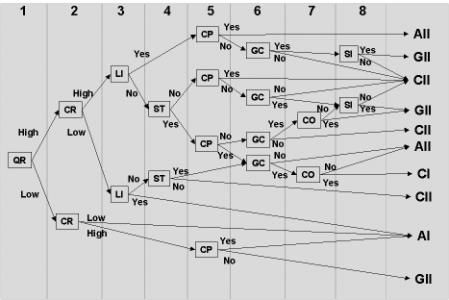
Vroom’s & Yetton’s ‘Decision Tree’.
|
Decision Making
Style |
Description |
|
Autocratic l (Al) |
Leader solves the problem along using information that is
readily available to him/her |
|
Autocratic ll (All) |
Leader obtains additional information from group members,
and then makes decision alone. Group members may or may not be informed. |
|
Consultative l (Cl) |
Leader shares problem with group members individually, and
asks for information and evaluation. Group members do not meet collectively,
and leader makes decision alone. |
|
Consultative ll (Cll) |
Leader shares problem with group members collectively, but
makes decision alone |
|
Group ll (Gll) |
Leader meets with group to discuss situation. Leader
focuses and directs discussion, but does not impose will. Group makes final
decision. |
Description of the outcomes from Vroom’s & Yetton’s ‘Decision Tree’.
2.4 Functional or Group Theories
2.4.1 Adair’s Action-centred Leadership
Adair’s (1979)[21] prescription is that the action-centred leader gets the job done through the work team and relationships with fellow managers and staff. This is a simple but reasonably useful (for junior management and team leader training purposes) account of the role "functions” of a leader. According to Adair's explanation and action-centred leader must:
- Direct the job to be done (task structuring).
- Introduce, support and review the individual people doing it.
- Coordinate and foster the work team as a whole.
His trefoil model (three circle diagram), as implication of the variability of human interaction, is a first step device for thinking about what constitutes an effective leader/manager in relation to the job he/she has to do.
The effective leader/manager carries out the functions and exhibits the behaviours depicted by the three circles.
- The leaves extend beyond us, according to the specifics of the task/situation, the demands of role performance overlap.
- The effective leader, situationally responsive, "brings into play" those leadership behaviours that enable the demands to be met.
- The problem imperatives and the variables will range across timing, quality, costs, the experience and capacity of the individuals and the team that have to do the work.

Adapted by John Adair (1983), ‘Effective Leadership’, Pan[22]
Consequently, if budding team leader/managers can be given training and coaching to develop these situational relevant skills (their inventory of leadership ability) after that they will be better placed to be effective leaders.
Situational and contingent elements call for different responses by the leader. Hence imagine that the trefoil leaves may be bigger or smaller as the situation varies meaning that the leader will give more or less emphasis to the functionally oriented behaviours according to what the actual situation involves.
One expectation typical of most organisational society is that loyalty; shared values (reflecting organisational values) and team spirit need to be educated. There are not any business organisations - private, public or voluntary where this is not the case. Individual members of the organisation and work group need to know what is expected of them. For instance, the standards and tasks they must achieve to get the job done.
However the individual is not a mechanical predictable thing - having wants, preferences, aversions, behaviours, attitudes and ambitions and needs. The organisational leadership expectation is that each person needs encouragement and support in order to be an active member of the team.[23]
2.5 McGregor's "Theory X and Theory Y"
Douglas
McGregor in his book, "The Human Side of Enterprise" published in
1960[24]
has examined theories on behaviour of individuals at work, and he has
formulated two models, which he calls Theory X and Theory Y.
Theory X Assumptions
The
average human being has an inherent dislike of work and will avoid it if he
can.
|
|
|
|
|
Theory Y Assumptions
|
|
|
|
|
|
Comments on Theory X and Theory Y Assumptions
These
assumptions are based on social science research, which has been carried out,
and make obvious the possible which is present in man and which organisations
should recognise in order to become more effective.
McGregor sees these two theories as two quite separate
attitudes. Although, theory Y is difficult to put into practice on the shop
floor in large mass production operations, it can be used initially in the
managing of managers and professionals.[25]
In "The Human Side of Enterprise"[26]
McGregor shows how Theory Y affects the management of promotions and salaries
and the development of effective managers. McGregor also sees Theory Y as
conducive to participative problem solving.
It is
part of the manager's job to use authority, and there are cases in which this
is the only way of achieving the desired results because subordinates do not
agree that the ends are desirable.
However, in situations where it is possible to obtain
commitment to objectives, it is better to explain the matter fully so that
employees grasp the purpose of an action. They will then apply self-direction
and control to do better work - quite possibly by better methods, than if they
had simply been carrying out an order which they did not fully understand[27].
The situation in which employees can be consulted is one
where people are emotionally mature, and positively motivated towards their
work, where the work is sufficiently responsible to allow for flexibility and
where the employee can see his own position in the management hierarchy. If
these conditions are present, managers will find that the participative
approach to problem solving leads too much improved results compared with the
alternative approach of handing out authoritarian orders.
Once management becomes persuaded that it is under
estimating the potential of its human resources, and accepts the knowledge
given by social science researchers and displayed in Theory Y assumptions, and
then it can invest time, money and effort in developing improved applications
of the theory[28].
|
McGregor realises that some of the
theories he has put forward are unrealisable in practice, but wants managers
to put into operation the basic assumption that ‘staff will contribute more
to the organisation if they are treated as responsible and valued employees’. |
3. easyJet Airline Company plc.
3.1 Company Overview.
The area of the research will be
concentrated on a new and successful corporation during the last seven years,
in a new industry of low cost airlines.
easyJet is one of Europe's leading low-cost airlines. Since its first flight in
November 1995, the airline has been grown from a Luton base offering two routes
from Luton to Glasgow and Edinburgh, served by two Boeing 737 aircraft, to an
airline offering 30 routes from 16 European airports and flying 21 737 series
aircraft.
During the financial
year on 30 September 2000, the company reported pre-tax profits of £22 million
on a turnover of £263 million and carried 5.6 million passengers. The airline's
shares were formally admitted to the London Stock Exchange on 22 November 2000
at a price of 310 pence per ordinary share.
easyJet is majority owned by the Haji-Ioannou
family. Stelios Haji-Ioannou also controls other separate easyGroup companies
such as easyInternetCafe (formal easyEverything)
, easyCar (formal easyRentacar), and easyValue. There are no
"cross-shareholdings" between easyJet and these other easyGroup
Internet companies, although some "cross-marketing" agreements do
exist.[29]
The airline is based
on easyLand, a bright orange building adjacent to the main taxiway at Luton
Airport. In an industry where corporate HQs are generally considered to be the
ultimate status symbol, it is the very embodiment of the easyJet low-cost
ethos.
The concept of the company is to eliminate unnecessary costs that drives prices up and offer a low cost ticket that attracts many people as it has been proved. These ‘unnecessary costs’ involve the use of Internet as the major tool of selling seats. In January 2001 approximately 86% of all seats were sold over the Internet, making easyJet one of UK's biggest Internet retailers. Also the use of one type of aircraft (Boeing 737) reduces the maintaince costs. Furthermore, direct sales without travel agents to be involved, only by telephone or the Internet, paperless and ticket less operation, the use of secondary airports, help the company to have tickets in low and reasonable prices. Those are all actions that have as a result the reduction of fairs that the final customer will have to pay.
easyJet favours an informal company culture with a very flat management structure, which eliminates unnecessary and wasteful layers of management. All office-based employees are encouraged to dress casually. Ties are banned - except for pilots! Remote working and 'hot-desking' have been characteristics of easyJet since the beginning.[30]
This culture and leadership styles that easyJet supports will be identified in order to classify the role of leadership in the organisation and how this role affects the successful development of the company during the last years.
3.2 Stelios Haji-Ioannou
Born in Athens on 14 February 1967, Stelios
(a UK passport holder) is the second son of Loucas Haji-Ioannou, a Greek ship
owner. In 1987 he graduated from the London School of Economics and a year
later he took a Masters degree from the City of London Business School.[31]
At the age of 21 he joined his father's shipping company and at the age of 25 he established his own shipping company, Stelmar Tankers, which has offices in Athens and London. In November 1995, when Stelios was 28, easyJet began operations.
In June 1999, Stelios started a second business, easyEverything, and
the world's largest Internet cafe, in central London. easyEverything offers to
the consumers access to the Internet 24 hours a day for only £1. Four more
central London sites have been added since, as well as Amsterdam, Rotterdam,
Edinburgh and Barcelona. It is expected that, in the region of 60 shops -
including one in New York - will be open by the end of 2001.
easyRentacar was launched in April 2000 - the world's first
internet-only car rental company. Contrary to the traditional model of car
rental companies, the easyCar fleet consists of a single model - the Mercedes
A-Class and offers car rental from only £9 per day.
In November 2000, Stelios launched easyValue.com, an online price
comparator, which continues in the kind of using information technology to
re-engineer business processes and provide goods and services to consumers at
vastly reduced prices. Another planned company, easyMoney, will provide a range
of online financial services, again eliminating the existing real estate costs
from this industry to reduce costs to customers.
Stelmar and all of the companies within the easyGroup are
"paperless" which allows Stelios to run these companies from wherever
he is in the world through his laptop.[32]
The above personality could be characterised as someone with
considerable leadership traits. Mr Haji-Ioannou has determination, knowledge,
skills, public profile and imagination. Those are human characteristics that
belong to a leader and following the development and achievements of Stelios;
we have to consider him as one of the great leaders. In one of his interviews
in a Greek Magazine Kephaleo (Capital) he states, “there are two types of
business talents, the entrepreneur and the manager. One is the pioneer that
takes the risks to start something from the beginning. I am certainly the first
as I believe that I am better in the role of mentor”.[33]
4. Conclusions
There are seven characteristics that are most
frequently found in successful business leaders.
1. Flexibility. Leadership needs the
ability to constantly set broad, new goals.
2. A capacity to inspire others - recognise
that people are the assets. It is the leadership mind that liberates these assets.
3. Enthusiasm. By being a continuous
improvement leader.
4. The ability to build relationships. Leaders
must build relationships with everyone involved in the organisation.
These relationships will create greater job
satisfaction and a greater sense of loyalty. There will be a greater
understanding with the organisation, and a closer employer-employee
relationship.
5. To inspire trust - empowerment will
endure. Good leadership will create organisational culture changes in their
workers. Leadership skill will become more a process of tying in individual
needs into the organisation’s needs.
6. Communicate. The ability to relate
to employees who are going through fundamental shifts due to empowerment means
communication. Leadership will need to tap into employees’ emotions and
feelings and have a greater sense of their values.
7. A willingness to experiment. Leadership
needs to support high levels of experimentation, unplanned, that produce new
and unexpected paths of progress and move along into the framework of the
organisation. Commitments to brave, daring projects need to become
characteristics of the organisation.
That is exactly
what easyJet seems to support with the use of a charismatic and innovating
leader, Mr Stelios Haji-Ioannou aiming to develop and change a new environment
of technological debate. All the indications from the development of the
company’s position and the recent success into the market together with the
results from this research that present the picture of its leadership position,
support this.
Allowing
organisational experimentation is clearly shown in the philosophy of Hewlett
and Packard, a visionary company. As stated in Collins book “Built to Last”
about Hewlett Packard:
“Hewlett Packard
Company learned early in its life due to a string of failed and only moderately
successful products. Yet Bill Hewlett and Dave Packard kept tinkering,
persisting, trying, and experimenting until they figured out to build an
innovative company that would express their core values and earn a sustained
reputation for great products. Trained as engineers, they could have pursued
their goal by being engineers. But they did not.
Instead, they
quickly made the switch from designing products to designing an organisation
creating an environment conducive to the creation of great products”.[34]
Today’s leaders do not focus on leadership title or position power over the people they lead. Changes in today’s organisational makeup may mean that people at all levels may be called upon to be leaders at one time or another. It is fundamental the consideration of every theoretical attempt in the past to be consider in the development of leadership today, but more important is to define the change of needs and to develop a suitable leadership style that each organisation suit into individually.
5. Recommendations
The aim of this project is to evaluate the operation of easyJet Airline Company and to find out, as a result of this evaluation, the importance of leadership in the organisational structure. It is fair to bring to a close that the importance of leadership is high, especially with corporations that the element of human interaction is involved. Communication and ability to express opinions is important to exist between members of a team together with a democratic environment of interaction.
However, there are some implications that should be considered on the above results. The structure of each corporation does exist by following a framework of strategic plan. This strategic plan is usually constrained from financial, political and most important human and managerial implication, different for each business each time – Internet based or not. Specifically, in the example of easyJet, it is not possible to assume that every part of the team within the group will be in a position to correspond in the needs of others within the group or to express personal opinions and recommendations. Personalities of several human beings are not following certain characteristics will not respond or even will not communicate with others. The human factor involves to the above, something that has to be considered on the real world of business.
Moreover, managerial implications will also be involved, people that will not contribute into the leadership style that the company is following, as they do not believe that should come into the same level as their employees, part of the management that is related to the personal scopes and expectations.
Financial, the implementation of a leadership style does not have any implications. It is possible although for some organisations the need to invest in training and retraining, in order to educate existing employees and most importantly management, on the new environment of change.
6.
References